1. Bay Leaf (Laurus nobilis)
Bay leaf is the herb you reach for when something is stuck. It's traditionally worked for block busting, road opening, and strength — clearing what's in the way, then giving you the backbone to walk through the opening. The classic bay leaf spell is simple enough to do tonight: write your intention on a large bay leaf and burn the leaf while you repeat that intention out loud. No special tools, no perfect moon phase. Burning bay leaves is one of the oldest and most direct forms of intention work, which is probably why it's the first spell a lot of people learn — and why practitioners keep coming back to it decades in.
Magical Uses: Block Busting | Road Opening | Strength
Ritual Uses: Write an intention on a large bay leaf. Burn the leaf as you repeat your intention.
Work with Bay Leaf:
2. Lavender (Lavandula angustifolia)
Lavender is the herb you reach for when the volume needs to come down. It's traditionally worked for purification, happiness, peace, and love — and it's one of the few herbs that works in both directions at once: it clears the stale energy out of a room and settles the person standing in it. Add it to a spell jar for love and happiness, or burn a lavender candle at bedtime to ease into sleep. It's forgiving, too. Burn it, bathe in it, spray it, or dress a candle with it — lavender doesn't need a complicated setup to do its job, which makes it a good first herb and one most practitioners never stop reaching for.
Magical Uses: Purification | Happiness | Peace | Love
Ritual Uses: Use lavender in spell jars for love and happiness. Burn a lavender candle or use lavender spray at bedtime to induce sleep.
Work with Lavender:
3. Rosemary (Salvia rosmarinus)
Rosemary is the workhorse. It's one of the oldest incense herbs on record — burned for cleansing and purification long before anyone wrote the practice down — and it's traditionally worked for purification, mental powers, and protection. That combination is why it turns up everywhere: it clears a space, sharpens a mind, and guards a threshold, all with the same sprig. Put it under your pillow for good sleep and to keep nightmares off. Hang it by the door to keep negative energy out of the house. Old tradition holds that where rosemary grows well, the household is in good order — which is either useful folklore or a note about your gardening, depending on the day.
Magical Uses: Purification | Mental Powers | Protection
Ritual Uses: One of the oldest incense herbs — cleansing and purifying, especially for ritual. Placed under the pillow, it ensures good sleep and drives away nightmares. Hung by the door, it protects the house from negative energies.
Work with Rosemary:
4. Rue (Ruta graveolens) — "Mother of Herbs"
Rue earned its folk name by being the herb people reach for when they need something that actually holds. It's traditionally worked for abundance, mental powers, protection, and luck, and it shows up across the Americas in exactly the practices nobody skips. In Puerto Rico, using rue soap on New Year's Eve clears out the old year before the new one starts. In Mexico, a sprig gets carried to the cemetery so spirits don't follow you home. Both are the same instinct: rue puts a boundary between you and whatever is looking for a way in. It's a working herb rather than a gentle one — which is the point, and also the reason to handle it with some respect. Rue can irritate skin and makes it more sensitive to sunlight, so wear gloves with the fresh plant, and skip it entirely if you're pregnant.
Magical Uses: Abundance | Mental Powers | Protection | Luck
Ritual Uses: Rue can be used for good luck and abundance. In Puerto Rico, they bathe with Rue soap on New Year's Eve. In Mexico, they carry it when going to a cemetery, to keep spirits from clinging.
Work with Rue:
5. Mugwort (Artemisia vulgaris)
Mugwort is the dream herb. It's traditionally worked for strength, sleep, and prophetic dreams, and it has a long reputation for thinning the wall between waking and whatever's on the other side. Tuck some into your pillow and your dreams get louder and more specific — sometimes more than you bargained for. Keep it next to the bed to encourage astral projection. Burn it with sandalwood or wormwood before a tarot reading or any divination work, to settle the room and sharpen what comes through. Mugwort pairs well with keeping a dream journal, because the whole point is remembering what you saw.
Magical Uses: Strength | Sleep | Prophetic Dreams
Ritual Uses: Put some in your pillow for prophetic dreams. Place next to the bed to encourage astral projection. Burn with sandalwood or wormwood before divination — a tarot reading, for example.
Work with Mugwort:
6. Rose Petals (Rosa spp.)
Rose is the one everybody thinks they already know. It's traditionally worked for luck, love, divination, and healing — and the love it carries is broader than the romantic kind, which is why it turns up in grief work and self-love rituals as often as in courtship. Add dried petals to a spell jar for love. Keep a small bowl of them on your altar and you have a standing foundation for love-magic that doesn't need rebuilding every time you sit down. A tea of dried rose petals before sleep is a traditional way to invite prophetic dreams. Rose is forgiving and slow — it works more like water than fire, which is why it tends to be the herb people come back to after the dramatic ones have worn them out.
Magical Uses: Luck | Love | Divination | Healing
Ritual Uses: Make a spell jar and add dried rose petals for love. Place a small bowl of dried rose petals on an altar for powerful love-magic. A tea of dried rose petals before sleep may induce prophetic dreams.
Work with Rose Petals:
7. Chamomile (Matricaria chamomilla)
Chamomile is the sunny one. It's traditionally worked for sleep, love, and purification, and it carries a long side reputation as a gambler's herb — hands washed in chamomile were said to pull money back toward the table. Add dried chamomile to a spell jar for purification and money. That same sunny nature is what makes it useful against spells and curses: it doesn't fight them so much as make the room inhospitable to them. And a cup of chamomile tea before bed is the oldest sleep working there is — so ordinary that most people have forgotten it counts as one.
Magical Uses: Money | Sleep | Love | Purification
Ritual Uses: Make a spell jar and add dried chamomile for purification and money. The sunny nature of chamomile may be used to combat spells and curses. A tea of dried chamomile before bed may help induce sleep.
Work with Chamomile:
8. Cinnamon (Cinnamomum spp.)
Cinnamon is fire in powdered form. It's traditionally worked for abundance, success, and protection, and it moves fast — where rose is water and chamomile is sun, cinnamon is heat. It doesn't add a new intention so much as accelerate the one you already set, which is why it shows up in money work, manifestation, and protective spells alike. It also lifts positivity, sharpens focus, and gets stalled creative work moving again. Sprinkle it on a candle during a manifestation ritual, add it to a spell jar, or stir it into your tea to boost your own energy. The one caution is the same as its strength: cinnamon speeds up whatever it's attached to, so be reasonably sure you want the thing you're asking for.
Magical Uses: Abundance | Success | Protection
Ritual Uses: Sprinkle on candles during manifestation rituals, use in spell jars, or add to tea to boost personal energy.
Work with Cinnamon:
9. Juniper Berries (Juniperus communis)
Juniper is the herb of holding the line. It's traditionally worked for resilience, energetic purification, and protection — and unlike herbs that clear a space in one sweep, juniper keeps working, which is why it lives in pouches and charm bags rather than in a single burning. Hang a small cloth bag of dried berries near an entryway or window to block what you don't want coming through. Sew the berries into a charm bag to support lasting recovery, spiritual and physical both. Juniper has been burned for purification in more traditions than almost anything else on this list, and the dried berries carry that same work in a form you can keep in a pocket.
Magical Uses: Resilience | Energetic Purification | Protection
Ritual Uses: Protective pouches — small cloth bags filled with dried berries, hung near entryways or windows to block malevolent forces. Amulets — dried berries sewn into charm bags to encourage lasting spiritual and physical recovery.
Work with Juniper Berries:
10. Salt
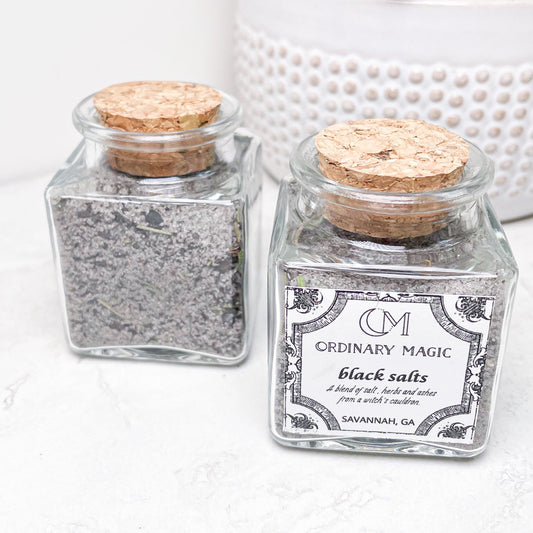
Salt isn't an herb — it's a mineral, and the oldest tool on this page. It's traditionally worked for purification, protection, and absorption, and it appears in nearly every tradition that has a word for "clean," because it does the job plainly. Sprinkle it across a threshold to keep negative energy out of the home. Cast a circle with it before ritual work for the same reason: salt draws a line and holds it. Where some herbs ask you to believe something, salt mostly asks you to be consistent. Black salt adds banishing to that same work; protection salt is blended to absorb what it blocks.
Magical Uses: Purify | Protect | Absorb
Ritual Uses: Sprinkle on thresholds to protect the home from negative energies. Cast circles with it for ritual work, for the same reason.
Work with Salt: